
BIPV
March 18, 2026
If you own or manage a commercial building portfolio, you already know that the facade is one of the largest capital line items in any retrofit or new-build project. What few owners realize is that in 2026, a Mitrex Building-Integrated Photovoltaics (BIPV) facade does not just pay for itself through energy savings. In well-structured projects, it can also unlock a layered stack of government incentives that recovers a substantial portion of project cost before a single kilowatt-hour is generated.
This guide breaks down how the incentive landscape works in Canada and the United States, how to layer programs intelligently, and what a real project can look like after incentives are applied.
Several major U.S. programs face legislated deadlines in 2026, which creates genuine urgency for projects still in planning or early design. Those deadlines are highlighted throughout.
Most building owners treat a BIPV facade as a single capital expenditure. A more strategic approach is to treat it as a funded building upgrade that draws from multiple layers of support at the same time.
This is the largest and most reliable layer. Both Canada and the United States offer federal credits of up to 30% of the eligible system cost, although the structure differs significantly between the two countries. U.S. projects may also qualify for bonus adders on top of the base credit. Canada currently does not have an equivalent adder structure.
This is a tax write-off that allows eligible businesses to depreciate the asset in the first year or two, generating additional cash value against taxable income.
This layer can take the form of a rebate, performance payment, or low-interest financing program that further reduces out-of-pocket costs.
When these layers are properly sequenced and stacked, well-structured projects in qualifying jurisdictions can significantly offset BIPV facade costs. In some cases, they may recover 50% or more before energy savings are counted. Actual outcomes depend on jurisdiction, entity type, tax position, project size, and program availability. The worked example later in this article illustrates one realistic Ontario scenario.
Under the One Big Beautiful Bill Act (OBBBA), signed into law on July 4, 2025, the eligibility windows for several major U.S. clean energy programs have been shortened.
For the Clean Electricity Investment Credit (48E) and the Clean Electricity Production Credit (45Y):
Section 179D
For the Energy Efficient Commercial Building Deduction (179D):
“Beginning of construction” has a specific legal meaning under IRS guidance. In most cases, it requires the start of physical work of a significant nature on the facility. Under IRS Notice 2025-42, the 5% safe harbour is generally not available for satisfying the OBBBA construction-start deadline, except for low-output solar facilities of 1.5 MW AC or less.
For building owners and developers with BIPV projects in feasibility, design assist, or early planning, these deadlines are not abstract. The qualifying window is measured in months, not quarters.
Source: IRS Notice 2025-42
The Section 48E Investment Tax Credit provides a credit on eligible system cost for commercial BIPV installations placed in service after 2024.
For most commercial BIPV projects, compliance with Prevailing Wage and Apprenticeship requirements is the practical path to the full 30% rate.
These may be stacked on top of the 30% base:
A project qualifying for multiple adders can reach a substantially higher effective credit. Most commercial BIPV projects will realistically target the 30 to 40% range, with higher outcomes reserved for projects that meet multiple adder thresholds.
Additional notes:
Source: IRS Clean Electricity Investment Credit, IRS Notice 2025-42
Solar and BIPV systems qualify for the Modified Accelerated Cost Recovery System (MACRS) 5-year depreciation schedule.
For corporations with sufficient taxable income, this can generate meaningful additional tax value beyond the federal credit. Bonus depreciation rates continue to phase down annually, so project teams should confirm the applicable rate for their tax year with a qualified advisor.
Source: IRS Cost Recovery, Section 179 and Bonus Depreciation
Under the OBBBA, Section 179D is terminated for property whose construction begins after June 30, 2026.
For qualifying projects that begin construction before that date, Section 179D provides a per-square-foot deduction for energy-efficient improvements to commercial building envelopes and mechanical and electrical systems.
Mitrex BIPV can support 179D eligibility by improving total building energy performance through on-site generation. Eligibility should always be confirmed by a qualified energy modeller or tax advisor.
Source: IRS Form 7205 / related 179D guidance
Commercial Property Assessed Clean Energy (C-PACE) provides long-term financing that is repaid as a line item on the property tax bill.
For BIPV projects, this can be particularly powerful because it allows owners to finance:
C-PACE is active in many major U.S. states and can allow projects to proceed with little or no upfront capital while federal tax credits and depreciation benefits are realized separately.
Source: U.S. Department of Energy C-PACE Programs
The NY-Sun MW Block program provides upfront incentives for commercial solar installations. In New York City, the SEGS Tax Abatement offers a multi-year property tax benefit for qualifying systems placed in service within the current program window.
The SMART program provides long-term compensation payments over 20 years for commercial solar projects. Compensation varies by utility territory, system size, and applicable adders.
The SuSI program provides fixed Solar Renewable Energy Certificate pricing for commercial and community solar projects.
Illinois Shines provides upfront Renewable Energy Credit payments for commercial and multi-residential solar installations. Rates vary by project size, category, and project type.
California’s SGIP program provides battery incentives for solar-plus-storage systems. In addition, the 2022 Title 24 Part 6 Building Energy Efficiency Standards require many new nonresidential buildings within specified occupancy categories to install solar PV and battery storage based on building type, conditioned floor area, and climate zone.
Canada’s Clean Technology ITC provides a refundable 30% tax credit on the capital cost of eligible clean technology property, including solar electricity-generating equipment.
For BIPV projects, the portion of project cost that qualifies as eligible clean technology property, as distinct from cladding, finishing, or structural scope, requires project-specific tax review under CRA guidance.
Source: Canada Revenue Agency
On February 13, 2026, the Government of Canada launched a consultation on potential domestic content requirements under both the Clean Technology ITC and the Clean Electricity ITC. No draft legislation or follow-up guidance has yet been published. Projects extending into late 2026 or 2027 should continue to monitor this file.
For municipalities, universities, hospitals, and Indigenous communities, a separate Clean Electricity ITC of 15% is currently available under draft legislation before Parliament.
Eligible solar generation equipment qualifies for accelerated depreciation under federal CCA classes for clean-energy assets.
Under Finance Canada’s temporary enhanced first-year allowance measures, a qualifying property acquired and available for use in 2026 may be eligible for an enhanced first-year deduction. The final applicable rate should be confirmed with a qualified tax advisor based on acquisition timing and current CRA guidance.
Source: Canada Revenue Agency, Accelerated Investment Incentive
Ontario’s Save on Energy program offers cash rebates under the Custom Stream for behind-the-meter solar installations.
The City of Toronto’s Hi-RIS Program also offers low-interest financing repaid via property tax for older high-rise residential rental buildings undertaking energy-efficiency and envelope improvements.
Source: Save on Energy, City of Toronto Hi-RIS
The Strategic Energy Management for Industry (SEMI) program supports industrial and commercial capital energy retrofit projects.
Eligible organisations may receive:
In addition, municipal CEIP financing is available in Edmonton and Calgary and is repaid via property tax.
Commercial solar systems under 5 MW in Alberta may also be eligible to generate verified carbon offset credits under the province’s micro-generation protocol, subject to registration and market pricing.
Source: Emissions Reduction Alberta SEMI, Alberta micro-generation / offsets guidance
CleanBC Custom offers incentives tied to greenhouse gas reduction for commercial and institutional energy projects. BC Hydro also offers commercial solar PV rebates based on installed capacity, with additional value available when paired with battery storage. Eligibility criteria include system size caps and contractor requirements.
Source: BC Hydro Solar and Battery Rebates
Technoclimat provides variable innovation grants for commercial and institutional clean-energy projects based on project scope and programme fit.
Source: Technoclimat program page
The following example illustrates one potential outcome for a taxable Canadian corporation with a commercial building in Ontario. It assumes the project qualifies for Save on Energy, the federal Clean Technology ITC, and accelerated depreciation treatment.
This is an illustrative scenario only. Actual results depend on system size, tax position, programme eligibility, and CRA confirmation of qualifying cost.
In this example, roughly 48% of the project cost is offset before energy savings are counted.
The remaining balance is then recovered over time through energy generation and utility savings. A project-specific financial model should always account for your building’s consumption profile, local utility rates, and expected system output.
For U.S.-based owners applying the federal ITC, MACRS depreciation, and a state or C-PACE programme, comparable stacking outcomes may also be achievable, subject to programme deadlines and project eligibility.
This article provides general information only. Tax benefits, programme availability, and eligibility rules vary by project, jurisdiction, and entity type. Always consult qualified tax and legal professionals for project-specific advice. All programme details referenced here are based on official government and programme sources available in early 2026
News & Articles

In commercial construction, even minor delays can carry significant consequences. Tight schedules, multiple trades, evolving site conditions, and coordination across disciplines leave little room for systems that require extensive customization or specialized installation practices. Historically, Building-Integrated Photovoltaics have been perceived as complex, innovative in concept but challenging to execute. At Mitrex, we've taken a different approach. Our goal has always been to make solar facades function like a true building material: practical to install, responsive to real-world construction conditions, and adaptable to the needs of modern projects.
In commercial construction, even minor delays can carry significant consequences. Tight schedules, multiple trades, evolving site conditions, and coordination across disciplines leave little room for systems that require extensive customization or specialized installation practices. Historically, Building-Integrated Photovoltaics have been perceived as complex, innovative in concept but challenging to execute. At Mitrex, we've taken a different approach. Our goal has always been to make solar facades function like a true building material: practical to install, responsive to real-world construction conditions, and adaptable to the needs of modern projects.
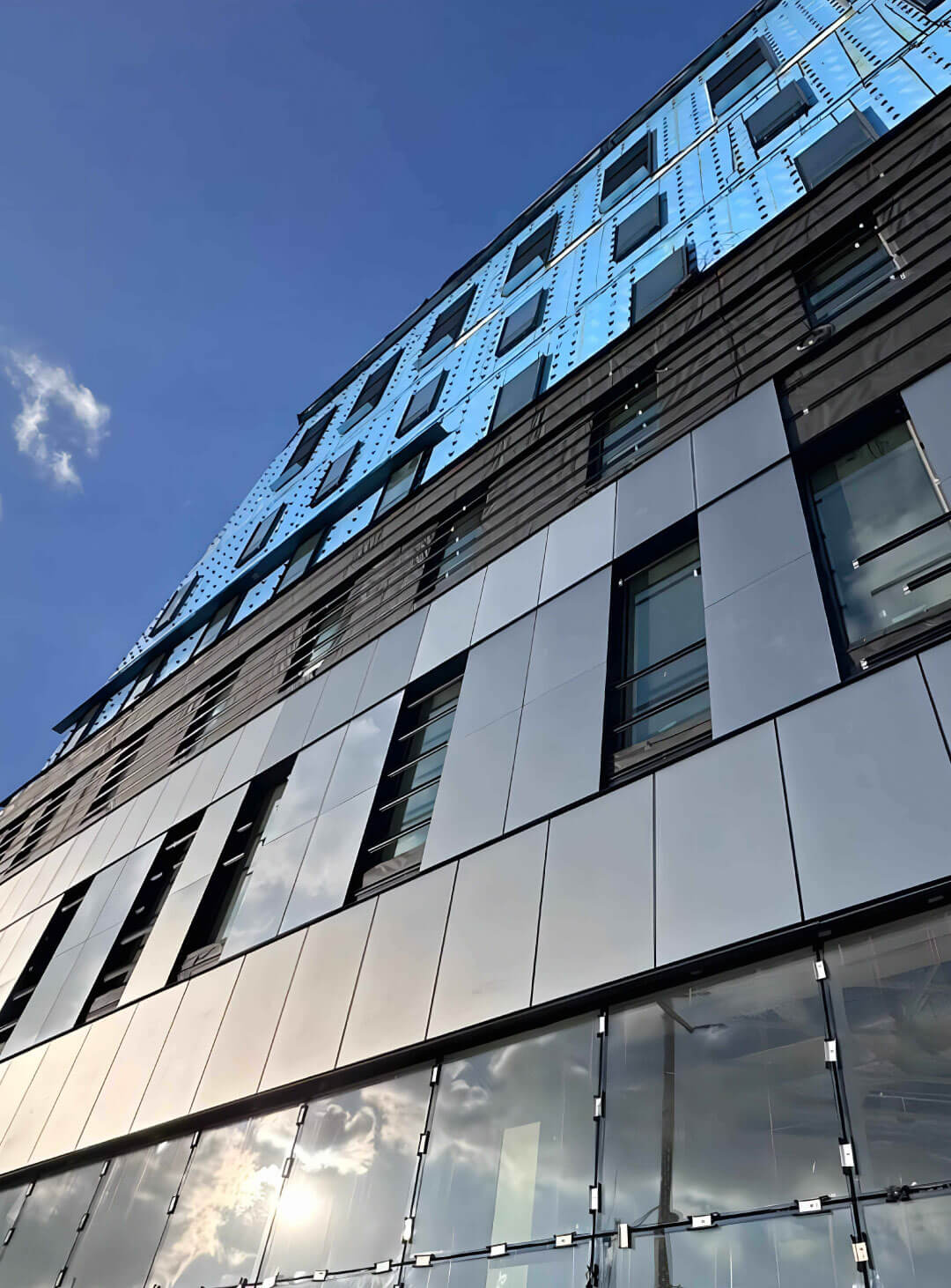
Mitrex solar facades combine the function of building cladding with long-term on-site energy generation, transforming the building envelope into an income-generating asset. While upfront costs may exceed conventional materials in some scenarios, stacked incentives, operational savings, and long-term durability significantly improve lifecycle value and payback performance.
Mitrex solar facades combine the function of building cladding with long-term on-site energy generation, transforming the building envelope into an income-generating asset. While upfront costs may exceed conventional materials in some scenarios, stacked incentives, operational savings, and long-term durability significantly improve lifecycle value and payback performance.

Mitrex solar facades are backed by a lifetime product warranty and a 25-year performance warranty, ensuring both material integrity and long-term energy output. With optional labour coverage for full-scope installations, this article explains how Mitrex warranties provide confidence, reduce project risk, and support long-term asset performance
Mitrex solar facades are backed by a lifetime product warranty and a 25-year performance warranty, ensuring both material integrity and long-term energy output. With optional labour coverage for full-scope installations, this article explains how Mitrex warranties provide confidence, reduce project risk, and support long-term asset performance

.svg)
