BIPV for Healthcare & Hospitals
Why Use BIPVs in Healthcare Facilities?
Scroll down
Why Use BIPVs in Healthcare Facilities?
Explore BIPV By
Industry Sector
BIPV & Healthcare Facilities
Healthcare facilities demand the highest standards of safety, reliability, and resilience. From structural integrity and aesthetics to sustainability, thermal efficiency, building acoustics, and security, façade design plays a key role in healthcare buildings. With Mitrex’s Building-Integrated Photovoltaic (BIPV) systems, the building envelope becomes an energy-generating asset—transforming facades, glazing, cladding, and curtainwall systems into sources of clean power, all while delivering premium architectural finishes.

Healthcare facilities have an increasing need for sustainable building design. Integrated energy-generating facades improve building envelope performance and support these facilities in achieving sustainable, reliable, and cost-efficient buildings.

Generally, healthcare facilities and hospitals expect their facilities to last for decades—so their architectural systems must deliver value over the full asset lifecycle. Asset value retention is built into the BIPV facade system through renewable energy payback, reduced operational costs over the building lifetime, and streamline implementation that reduces costs.

Operations in healthcare demand façade systems engineered for durability, minimal maintenance disruption, and long service life. Mitrex BIPVs reduce replacement and maintenance needs compared to traditional cladding systems through an extended service life and a high-performing system.

Whether for new builds, expansions or retrofits, healthcare campuses require façade solutions that integrate without major disruption to operations. Mitrex BIPV facades minimally contribute to operational disruption during installation, which is critical for healthcare facilities that have demanding timelines for new or retrofit projects.

Critical healthcare operations demand buildings that support energy-resilient design, micro-grids and backup power systems. With BIPVs, backup power can be supplied on site through the building facade, enabling energy-independent facades that keep patient care uninterrupted during grid disturbances.

Safety in healthcare architecture is non-negotiable—facades must meet rigorous global standards and perform under extreme conditions. Mitrex BIPVs are fully certified for healthcare-grade safety and durability in critical facility applications.
Plug and play BIPV in 5 colors and 2 sizes.
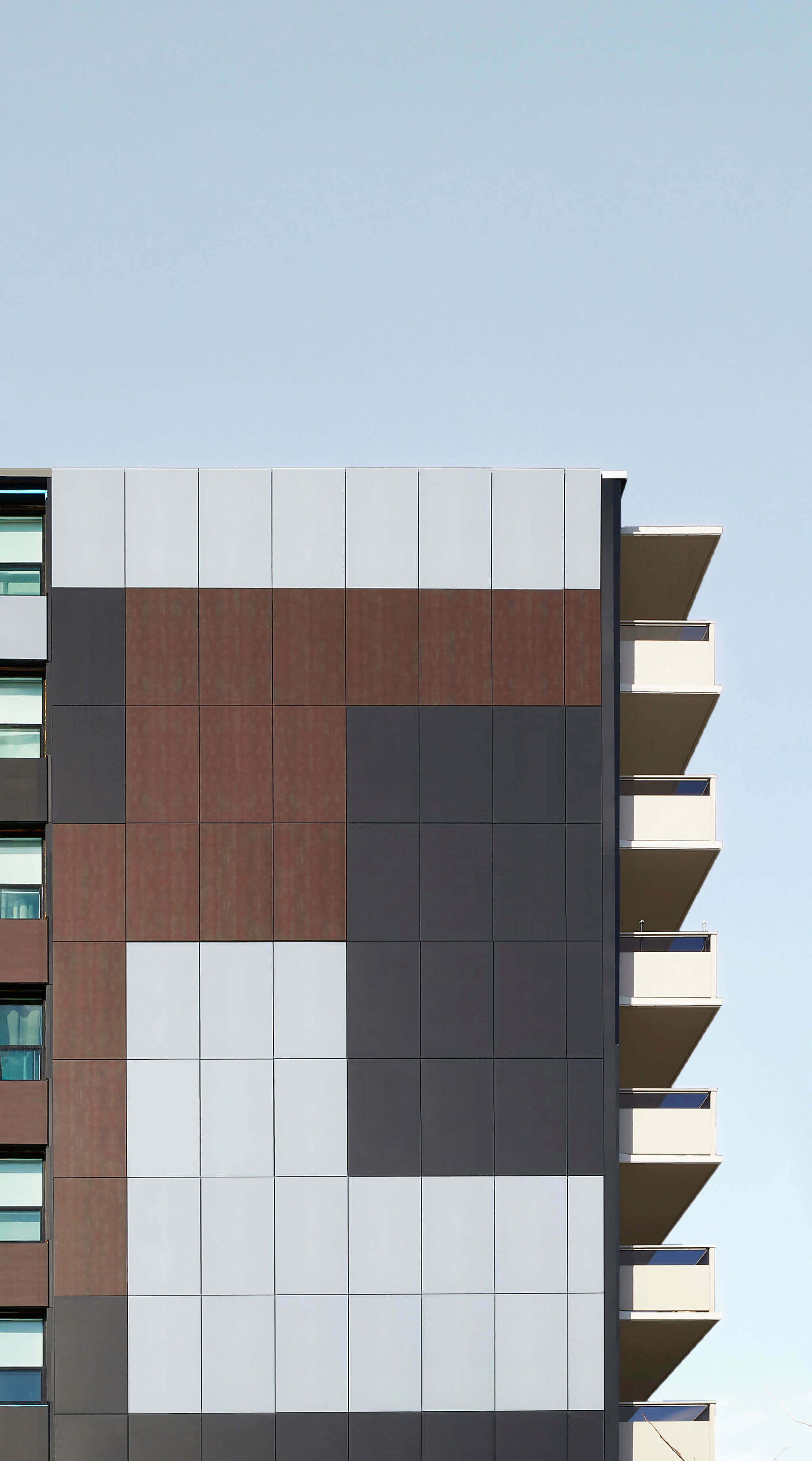
Large colorway with rainscreen system.

Custom BIPV in any color, size & system.

Angled BIPV architectural panels.
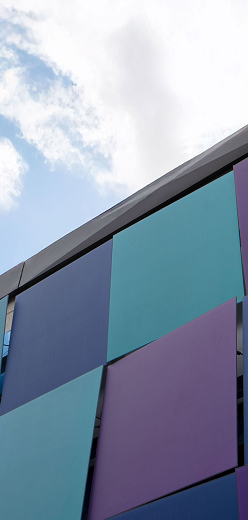
High-performance, energy-generating architectural glass.

Mitrex BIPV turns façade, glazing, and cladding into on-site power source, helping hospitals generate clean electricity directly from building envelope. This supports microgrids, battery storage, and backup systems so critical zones like ICUs, emergency departments, operating rooms, and data centers can maintain power during grid disturbances. The integration helps ensure operational continuity for essential medical services and reduces dependence on grid infrastructure. BIPV can be designed to prioritize critical loads and integrate with existing emergency power systems.
Systems are designed for low-disruption installation with prefabricated panels, phased work, and minimal noise or vibration, so hospitals and clinics remain fully operational during construction. Work can be sequenced by wing or elevation and scheduled around sensitive areas (surgical suites, ICUs, imaging) and off-hours to limit impact on patients, staff, and clinical services. Most installation occurs from exterior using swing stages or mast climbers, minimizing interior disruption. We coordinate closely with hospital facility managers to develop installation sequences that maintain continuous healthcare operations.
Mitrex uses low-embodied-carbon materials with full Life Cycle Assessments and Environmental Product Declarations, so energy generation and embodied impacts can be documented for LEED for Healthcare, BREEAM Healthcare, and ESG reporting. On-site clean energy directly reduces operational carbon and supports hospital net-zero and resiliency goals. This aligns with healthcare sector commitments to environmental stewardship, Practice Greenhealth initiatives, and community health through reduced emissions. The visible sustainability features also support hospital mission statements and community engagement.
BIPV façades are designed for 60+ years of performance with lifetime product and energy performance warranties plus comprehensive life-cycle cost analysis. Maintenance is similar to high-quality glazed façade—visual inspections and periodic cleaning—while self-cleaning coatings and durable construction reduce access, labor, and replacement needs over facility lifespan. For healthcare facilities planning multi-decade operational horizons, the low maintenance requirements and long service life provide predictable operating costs and reduce disruption from façade maintenance activities near patient care areas.
Yes. The system integrates into new construction, expansions, and recladding projects using prefabricated panels and compatible subframing to replace or overlay existing cladding. This allows hospitals to modernize façades, improve performance, and add solar generation without invasive structural work or interior demolition—critical for maintaining continuous healthcare operations. The lightweight system (around 5-7 lb/SF) is particularly well-suited for retrofits on existing structures where additional dead load is a concern. Phased implementation allows upgrading facilities wing-by-wing without full shutdowns.
Beyond sustainability commitments, BIPV reduces long-term operating costs by generating on-site electricity while providing maintenance-free façade. ROI models factor in energy yield, available incentives (hospitals often qualify for tax-exempt financing and grants), and reduced maintenance, showing how system improves lifecycle value and supports capital planning for large healthcare campuses. Energy savings can be redirected to patient care, equipment, and facility improvements. For healthcare systems managing multiple facilities, portfolio-scale implementation creates additional economies of scale.
When paired with battery storage, BIPV can provide backup power for critical loads including emergency lighting, communications, refrigeration, and limited HVAC. System sizing depends on load requirements and desired backup duration.
Yes, BIPV contributes multiple points in Energy & Atmosphere (renewable energy, optimize performance), Materials & Resources (EPDs, life cycle impacts), and Innovation categories.
Maintenance is similar to high-quality glass or metal façades. The exterior glass surface includes anti-soiling and hydrophobic properties reducing dirt build-up and making cleaning faster and less frequent. Routine maintenance typically involves visual inspections for damage or soiling and periodic cleaning aligned with your building's overall façade maintenance program. The system is designed to be virtually maintenance-free over its 60-year lifespan, significantly reducing long-term operating costs and access requirements compared to traditional cladding materials that may require refinishing, repainting, or replacement.
Our systems are engineered to meet international standards including PV & safety (UL 61730, UL 61215), impact and structural performance (ASTM E1996, ASTM E330), and fire performance (NFPA 285, CAN/ULC-S134, EN 13501 A2-s1,d0). Systems feature non-combustible components. For each project, we provide test reports, classification summaries, engineering letters, and product data sheets to support permitting and code compliance review. These documents are also available through our downloads page and can be provided during the specification phase.
Inspiration
Discover inspiring projects that showcase how Mitrex BIPV solutions enhance design, sustainability, and performance in modern facilities.

.svg)

.avif)