Explore BIPV
By Category
Every Component in a Building-Integrated Photovoltaic System
Explore BIPV
By Category
BIPV Components
A building-integrated photovoltaic system is not just the modules visible on the facade. Behind the architectural surface is a complete electrical generation and distribution system that converts sunlight into usable AC electricity and delivers it to the building's electrical infrastructure or the utility grid.
Understanding the full system matters for every discipline involved in a BIPV project. Architects need to know what space the electrical components require. Engineers need to understand how the system interfaces with the building's electrical infrastructure. Contractors need to know how wiring routes through the envelope. Building owners need to understand what they are investing in and how it operates. Each component plays a specific role, and the system only performs as intended when all elements are correctly specified and integrated.


Mitrex BIPV modules are the solar building materials themselves - the eFacade panels, Solar Glass units, SolaRail infills, and other products that replace conventional building materials while generating DC electricity. Each module contains photovoltaic cells encapsulated within a tempered glass assembly, rated in watts peak (Wp) under standard test conditions. Modules operate within a DC voltage range of 10V to 50V and support a maximum system voltage of 1,000V DC, compatible with the full range of commercial inverters on the market. MC4 connectors at the back of each module link adjacent modules into strings - connecting in series sums voltage while keeping current constant. All wiring routes through concealed conduit within the building structure, fully invisible from the exterior.
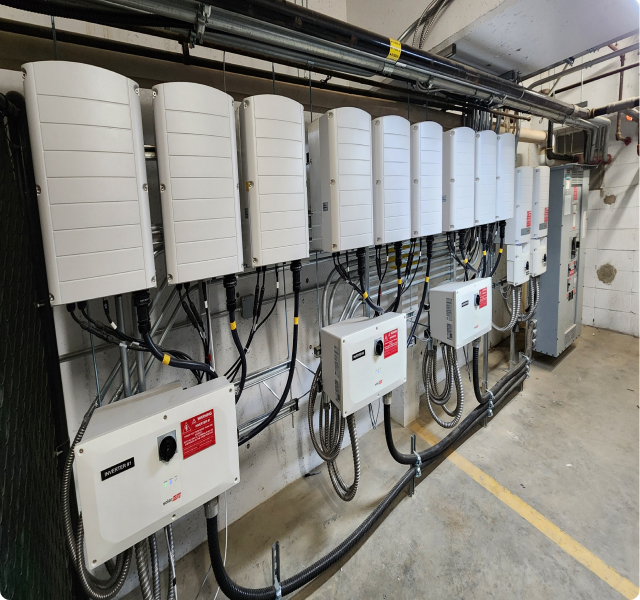
The inverter converts DC electricity generated by the modules into AC electricity compatible with the building's electrical system and the utility grid. Without an inverter, the electricity generated by BIPV modules cannot power any standard building load or be exported to the grid. Three inverter types are compatible with Mitrex BIPV systems. Microinverters convert DC to AC at each individual module - highest granularity for monitoring and fault isolation, best suited for smaller installations or complex shading environments. String inverters handle the output of one or more module strings and are the most common configuration for mid-size commercial installations. Central inverters aggregate multiple strings and are typically specified for large commercial or institutional BIPV projects where system scale justifies the centralized approach.
Microinverters offer module-level DC to AC conversion with maximum monitoring granularity, making them well suited to smaller installations or complex shading environments. String inverters are the most common configuration for mid-size commercial installations, while central inverters aggregate multiple strings and are typically specified for large-scale commercial or institutional applications where system scale justifies the centralized approach.

The rapid shutdown device (RSD) is a code-required safety component for all facade and rooftop solar systems under NEC 2017 and equivalent Canadian electrical codes. In an emergency, it de-energizes exterior DC conductors to 30V or less within 30 seconds of activation, protecting emergency responders from electrocution risk. It is a mandatory component of every Mitrex BIPV installation. DC power optimizers are optional module-level power electronics that decouple each module from string-level performance constraints. In a standard string, the lowest-performing module limits the output of the entire string. Optimizers eliminate this constraint, independently maximizing each module's output before passing it to the string - particularly valuable on facades where different elevations experience different shading profiles.

Battery storage is an optional addition that allows excess BIPV generation to be stored for later use rather than exported to the grid. This is most valuable where net metering rates are unfavorable, time-of-use pricing makes on-peak grid power expensive, or energy resilience is a project requirement. A PCS controller manages bidirectional power flow between the BIPV array, battery system, building loads, and grid. Monitoring software provides real-time and historical visibility into system performance - total generation by time period, string or module-level output, availability, fault alerts, and actual vs. projected performance comparison. Most modern inverter platforms include monitoring capability as a standard feature. A transformer and switchgear are required for larger installations to step up AC voltage for medium-voltage distribution or utility grid interconnection.
Battery storage stores excess BIPV generation for later use, and is most valuable where net metering is unfavorable, time-of-use pricing is high, or resilience is required. A PCS controller manages power flow between the array, storage, loads, and grid, while monitoring software, standard on most modern inverters, tracks generation, performance, and faults in real time. Larger installations also require a transformer and switchgear for grid interconnection.
Mitrex modules are compatible with virtually all commercial inverters. The optimal type and size depend on system scale, electrical infrastructure, and project requirements. The project's electrical engineer of record typically makes this specification. Mitrex's technical team can advise on compatibility.
No. Battery storage is optional. Most BIPV systems export excess generation to the grid under a net metering arrangement. Storage adds value where grid export rates are unfavorable, time-of-use pricing makes stored energy economically valuable, or energy resilience is a project requirement.
A rapid shutdown device de-energizes the exterior DC conductors of a solar system during emergencies to protect first responders. It is code-required for all facade and rooftop solar systems under NEC 2017 and equivalent Canadian electrical codes. It is mandatory on every Mitrex BIPV installation.
Yes, with module-level power electronics and compatible monitoring software. String-level monitoring is available with standard string inverters. Module-level monitoring requires optimizers or microinverters and provides visibility at the individual module level for precise fault detection.
The electrical system design is the responsibility of the project's licensed electrical engineer of record. Mitrex provides module specifications, electrical compatibility data, single-line diagram support, and technical coordination throughout the design process.
MC4 connector wiring runs from the back of each module through conduit embedded within the building envelope - typically routed vertically down the facade into the electrical room. The wiring is fully concealed and invisible from the exterior, maintaining the clean architectural appearance of the facade.
Projects
Each of our projects is a story of innovation and sustainable architecture.



.svg)